Sunday, 5 March 2017

Chapter 16: The Math Party

I challenge you to think back on a day where you did not use mathematics in any capacity. You are probably having a pretty hard time...Did you get dressed that day? Did you buy anything that day? Did you go on a timed break at work? Did you determine what time you need to get up in the morning on the following day? Well sorry to tell you, but if you did any of the above, then you probably used mathematics. The thing is, mathematics is everywhere...you just have to look. It may be discrete, it may be perceived as "easy" or "natural", but its mathematics, and most of us use it every single day.

So, welcome to the Math Party.

Image result for math party
http://weheartit.com/entry/group/42954734

I find that mathematics students are often very cynical when they are told they are "good at math". They are quick to revert back to statements such as "My parents are bad at math, and so am I", or "I've never memorized my times tables...I am no good at math", or my personal favourite "Math and I just don't get along". What these students do not know or understand is that there is nothing limiting their math success, and they are probably quite a bit better at mathematics than they believe. They just haven't been invited to the party yet. 

Let's pretend I am hosting a party. This is a pot-luck party, where everyone is expected to make their own dish to share with the rest of the guests. The idea, is that everyone brings something unique, something they are great at making, and something they are proud to share (and show off!). If its a great party, you get all sorts of great dishes (from light salads to deep-fried chocolate bars), everyone shares their amazing creations, and perhaps some even exchange recipes. 

Sounds like a pretty good party, right? Well let's bring this party to the mathematics classroom...but instead of a dish, let's have our students bring their personal and unique set of mathematics skills and experiences. Let's have them be proud and confident in what they bring to the table. Let's celebrate their diversity. Let's share and exchange our most amazing and creative math processes. Let's invite everyone to join. 

It's important that as mathematics educators, we recognize that everyone possess math skills that can be brought to, and showcased, in the classroom. We need to plan our lessons with the intention of inviting each and every one of our students to the "math party". In doing so, we can change the attitude of "Math and I just don't get along" to "Math and I? We go way back". 

Thanks for reading!


Chapter 15: Teaching Trig

How would you describe trig identities to a friend? I asked a peer this question, and they replied with something along the lines of "Isn't it that thing where you need to make each side match and they're really hard and each question takes up a page?". Nailed it. That isn't too far off from how I remembered trig identities, and I'm sure there are many others that were left with a similar memory.

For some reason, the perceived difficulty of a math question seems to always correlate with the amount of space the solution takes up on the page. Unfortunately, the questions presented in this unit innately promote their perceived difficulty as students rarely ever solve the question on their "first try".

Another way we describe trig identities is "as a puzzle". Again, this image sort of just paints trig identities with an ugly, difficult, long, and meticulous brush. Again, this description may or may not be fitting...but at least its consistent.

Hopefully by now, you've got the image in your head that trig identities are challenging, they may take up an entire page, and they are rarely completed successfully on your first try. They are guess-and-check type logic puzzles, much like Sudoku or KENKENS.

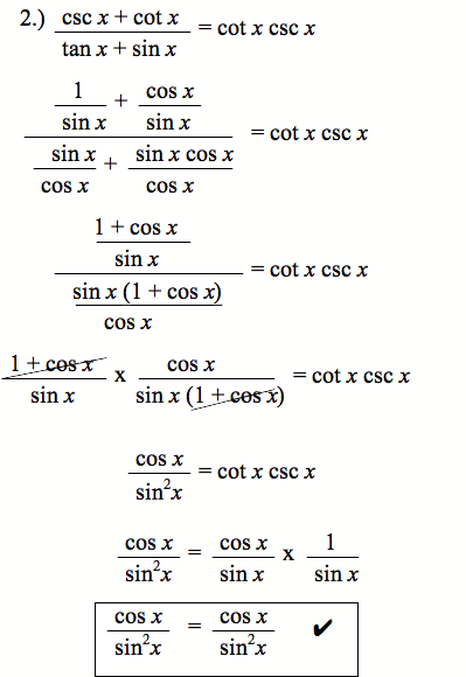
So how do we teach trig identities? I am not sure about you, but for me, I was taught through examples upon examples. An example would go up on the board, the teacher would solve it while he justified his solution, then we would move on to the next. The solutions often looked neat and crisp like the one below:
Image result for trig identities examples
http://verifyingtrigidentities.weebly.com/hard.html


"Puzzle? Where does that come from? These are EASY". Following along with the teacher felt great. I felt empowered to go on and solve the hardest trig identities the text had to offer. However, when attacking even the simplest questions without the guidance of the teacher, I felt lost, overwhelmed, and defeated. All of the preconceptions I had before the lesson came rushing back. Come to think of it, this is probably where my irrational hatred for puzzles came from...

I eventually practiced enough on my own in order to gain confidence with the topic, but I feel that the process could have been much easier. Why do we tell our students that something is challenging, thought provoking, and puzzle-like, only to model a solution using a key? It sets the  precedent that it only takes one try to find the solution. and anything that differs is "out of the norm".

In math education, we preach the "discovery of content"; students are able go take data they have collected or solved in order to find patterns and create formulas. I think that in certain areas of mathematics such as trig identities, we also need to preach the "discovery of process". Students need to discover that the process of solving mathematics is not always linear. It is okay to take a step back...it is okay to try something new...it is okay to get the wrong answer and start again. I found throughout my academic journey, I was able to learn the most from the mistakes that I made while at home trying to figure out how the heck my teacher was able to "get that answer". My goal as an educator is to facilitate this type of learning within my classroom.

Thanks for reading!


Tuesday, 21 February 2017

Chapter 14: Hockey Team Task

This week in class, we examined the "Data Management" topic of combinations and permutations. During the debriefing section of the presentation, we discussed different ways we have learned, taught, or observed this topic being taught. One of the methods discussed involved the use of baseball cards and creating teams/batting orders out of the cards.

This concept really resonated with me, and I used it as inspiration to create my own lesson on combinations and permutations using hockey cards. It would go something like this:

In groups of 3-4, provide students with 15 hockey cards (7 forwards, 5 defense-men, and 3 goalies). Tell the students that a starting lineup consists of 3 forwards, 2 defense-men, and 1 goalie.

Ask the students, how many different "starting forward lines" could you create with the players in your deck? 

Ask the students, how many different "starting defensive-pairs" could you create with the players in your deck? 

Ask the students, how many different "starting goalie options" would you have with the players in your deck? 

These questions could all be answered using combinations, as the order of selections doesn't matter.

Next, tell students that if a hockey game remains tied after regulation and over-time minutes, they conclude the game with a shootout. A shootout is where 3 (or more if required) players (typically forwards) are selected to shoot on the opposing team.

Ask the students, how many different 3-man "shootout lineups" could you create with the forwards in your deck? 

Ask the students, how many different 5-man "shootout lineups" could you create with the forwards in your deck? 

Here, order matters, so students would need to use permutations in order to answer the question.

This task could be delivered as an introduction to combinations/permutations as outlined above, however, it could easily be extended into a task to be completed once some of these skills have been further developed. 

For instance, students could be asked to create as many different complete starting lineups (3F, 2D, 1G) as possible. This would required them to treat forwards, defense, and goalies individually before creating a full line-up. 

Or, you could break down the forward groups into left-wing, center, and right-wing positions, and the defense into left and right positions and ask students to create lineups according to this order. This would require students to treat each of those positions as individual groups, much like the scenario above. 

Or, you could spiral the activity to incorporate the statistics of players in order to create a team with the best potential of scoring or stopping a goal. There are plenty of free websites that track the statistics of players, such as http://stats.hockeyanalysis.com/. 


The potential for extension of this task is almost limitless. 

Again, the idea of using hockey cards really resonated with me. The traditional "playing card" tasks associated with permutations and combinations always seem to lack context that is relevant to high school students. Hopefully a task such as this would get students genuinely interested in the math they are exploring. 


Chapter 13: Spaghetti Trig

The spaghetti task is designed to help students better their understanding of the unit circle, as well as develop a relationship between the unit circle and the graphs of trig functions. Essentially, students either develop, or are provided with a unit circle. They are then asked to wrap a length of string around the circumference of the unit circle. At each of the ordered pairs of each special angle, students should place a "dot" on the string using a marker. Once this is completed, the students would straighten the string and glue (or tape) it to a piece of paper (see the image below).
Next, students will measure and break pieces of spaghetti that run from each ordered pair point back to the baseline (horizontal axis) of the circle. These pieces would be glued (or taped) to their corresponding point on the string. The pattern created would either be a sine or cosine wave (see image below) depending on whether students measured the distance of an ordered pair to the vertical or horizontal axis.
Image result for spaghetti sine wave
https://www.pinterest.com/lesfleur87/trig/
I found this task to be a super refreshing take on a unit circle activity. The context of this sort of task almost always involves a Ferris wheel, which means the activity is typically completed on paper, and best-suits theoretical thinkers (most schools do not typically have a Ferris wheel on hand...). This activity however, is highly differentiated; I believe that students who have more success with visual/hands on thinking will be able to grasp the innately theoretical trig concepts presented in this unit. Another benefit of this activity would be the fact that students actually create a product that can be kept or displayed in order to "recall" the concepts learned.

These are the types of tasks that mathematics educators should aim to present as often as possible. Students want to create things, they want to discover relationships, and they want to have fun! I truly believe that we can tap into this intrinsic desire to learn math through this type of lesson.

Thanks for reading!

Thursday, 9 February 2017

Chapter 12: Utilizing the Context of Data

What percentage of your country's population is foreign-born? According to the data provided by "Our World in Data", if you are an American citizen, you probably over estimated the "correct" value. In fact, this data set suggests that many major countries (such as the Netherlands, France, and the United Kingdom) believe that the percentage of foreign-born citizens within their nation is higher than it actually is. This, and many other relevant data sets, can be found here.

There are three very important and beautiful facts about data: 
1) It is literally everywhere. 
2) Whatever the context, data can always be interpreted in a mathematics setting. 
3) Mathematics educators can utilize the context of data to extend dialogue well outside of the classroom.

Referring back to the question "what percentage of your country's population is foreign-born?", we can generate all sorts of math inquires. Let's take a look at the data chart provided in class:


The data modeled in this chart can be analyzed in many ways. For instance, students could be asked to determine which countries overestimated the share of immigrants in their population the most? The least? Why do you think each of those countries are where they are on this chart? Where do you think Canada would fall on this chart? The context of this data is relevant to current world issues; having students analyze this data should lead to important conversations that would have been difficult to facilitate in a mathematics classroom otherwise.

As mathematics educators, we need to shift away from using data sets such as "height vs age" or "shoe size vs height" in favour of those that explore issues related to class, race, gender, ability, age, faith, heteronormativity, language, social economic status, and mental health. Challenging "normal" ways of being and knowing within the mathematics classroom may seem like a daunting task, however, analyzing data with relevant context seems like a great way start rich conversations on equity issues. I look forward to practicing an exercise of this nature in a classroom of my own.

Have any other ways of incorporating/facilitating discussions related to social justice in the mathematics classroom? Comment below!


Wednesday, 1 February 2017

Chapter 11: Cup Stacking

This week in class, we looked at a seemingly simple question...

How many cups tall am I?

The thing I loved about this question, is how many ways a student would be able to look at this question, and how many ways an educator can facilitate the activity according to the information they provide. 

For instance, giving them absolutely no information, you could ask students what they would need to know to solve the problem. I would expect that they would want to know things such as:

-the teachers height
-the height of a cup
-how they are stacking them

You could then given them all of that information, however it still isn't enough to solve the problem if they are to stack the cups conventionally (see the image below).
Image result for stack of cups
         https://crazedmummy.wordpress.com/category/useful-for-teaching/


Concluding to the class that the cups must be stacked conventionally, you could then ask, what further information would you need to solve this problem? This conversation should lead to the height of the base and the lip of the cup. Given this information, students should be able to work through the problem, either numerically, graphically, or using a data table. Regardless of how the students solve the problem (assuming they are correct), they are exploring linear relations.


This is only ONE approach to the problem. Another great approach would be providing students with the height of two different stacks of cups. At this point, they would have to find the slope of a line using two points to solve the problem. Or, you could extend the problem by having students use different size cups. Or, you could actually just give the cups to the students and have them test their answers. Or, you could given them only a few cups and have them develop a solution on their own....

There are so many different ways this question could to presented, all of which should result in a unique learning experience. I find that as mathematics students/educators, we tend to value math questions based on their complexity, however, "seemingly simple" tasks such as this allows students to become more invested in the math. Stacking cups is tangible, and its "within reach" of students regardless of their academic achievement levels. They are not scared of the question. I think this is the key to unlocking the potential of students that identify as being "bad at math". 

Thanks!

Wednesday, 25 January 2017

Chapter 10: Why do we Invert and Multiply?

When dividing two fractions, we are taught to "invert and multiply" (and don't ask why). It is the rule that all math students inevitably learn, relatively few challenge, and fewer can rationalize. It is like wetting your toothbrush before adding toothpaste and brushing...you don't quite know why you do it, you just know it works.

This week in class, we were challenged to rationalize the "invert and multiply" rule. Why does it work? How can we explain why it works? How can we show that it works? Below is my thought process on why we are able to "invert and multiply" two fractions that are being divided:

Let's use the following equation:

1/2 ÷ 3/4

Since these fractions are being divided, we could rewrite the equation as:

1÷3 
2÷4

Now we have a fraction in the numerator (1/3) and a fraction in the denominator (2/4). We can now multiply the entire equation by the fraction of 3/3 (to get rid of the 3 in the numerator fraction) and 4/4 (to get rid of the 4 in the denominator fraction)...excuse my terminology!:

[(1/3) ÷ (2/4)] x (3/3) x (4/4)

which can also look like:


(1÷3)(3)(4)
(2÷4)(3)(4)

As you can see, multiplying then dividing by 3 in the numerator and 4 in the denominator would cancel the respective terms, leaving:

(1) x (4)     
(2) x (3)

 If we separate the terms, we see our rule... invert and multiply!

(1/2) x (4/3)

Image result for invert and multiply don't ask why
https://www.pinterest.com/explore/dividing-fractions/
The mathematics applied to this solution is not necessarily complex, and I am sure there are a million other more effective and simple ways to solve it (see the picture to the left). The point I am trying to make, is that, using either numbers, visuals, or manipulatives, mathematics educators should work with students to facilitate the derivation of the "invert and multiply" (and other!) math rules. An unexplained/non-derived formula or rule is a difficult concept to grasp, and passing it along without question promotes a passive style of learning which resonates with primitive methods of teaching. I truly believe that something as simple as collaboratively deriving the "invert and multiply" rule could drastically affect the confidence, and therefore academic ability, of all learners within a mathematics classroom.


Thanks!


UPDATE: Here is a link to essentially the same proof as the one shown in the blog, but shown in a much clearer manner! It also shows other ways of proving the "invert and multiply rule"!

http://www.mikesmathclub.org/div_fractions.pdf