For some reason, the perceived difficulty of a math question seems to always correlate with the amount of space the solution takes up on the page. Unfortunately, the questions presented in this unit innately promote their perceived difficulty as students rarely ever solve the question on their "first try".
Another way we describe trig identities is "as a puzzle". Again, this image sort of just paints trig identities with an ugly, difficult, long, and meticulous brush. Again, this description may or may not be fitting...but at least its consistent.
Hopefully by now, you've got the image in your head that trig identities are challenging, they may take up an entire page, and they are rarely completed successfully on your first try. They are guess-and-check type logic puzzles, much like Sudoku or KENKENS.
So how do we teach trig identities? I am not sure about you, but for me, I was taught through examples upon examples. An example would go up on the board, the teacher would solve it while he justified his solution, then we would move on to the next. The solutions often looked neat and crisp like the one below:
"Puzzle? Where does that come from? These are EASY". Following along with the teacher felt great. I felt empowered to go on and solve the hardest trig identities the text had to offer. However, when attacking even the simplest questions without the guidance of the teacher, I felt lost, overwhelmed, and defeated. All of the preconceptions I had before the lesson came rushing back. Come to think of it, this is probably where my irrational hatred for puzzles came from...
I eventually practiced enough on my own in order to gain confidence with the topic, but I feel that the process could have been much easier. Why do we tell our students that something is challenging, thought provoking, and puzzle-like, only to model a solution using a key? It sets the precedent that it only takes one try to find the solution. and anything that differs is "out of the norm".
In math education, we preach the "discovery of content"; students are able go take data they have collected or solved in order to find patterns and create formulas. I think that in certain areas of mathematics such as trig identities, we also need to preach the "discovery of process". Students need to discover that the process of solving mathematics is not always linear. It is okay to take a step back...it is okay to try something new...it is okay to get the wrong answer and start again. I found throughout my academic journey, I was able to learn the most from the mistakes that I made while at home trying to figure out how the heck my teacher was able to "get that answer". My goal as an educator is to facilitate this type of learning within my classroom.
Thanks for reading!
Another way we describe trig identities is "as a puzzle". Again, this image sort of just paints trig identities with an ugly, difficult, long, and meticulous brush. Again, this description may or may not be fitting...but at least its consistent.
Hopefully by now, you've got the image in your head that trig identities are challenging, they may take up an entire page, and they are rarely completed successfully on your first try. They are guess-and-check type logic puzzles, much like Sudoku or KENKENS.
So how do we teach trig identities? I am not sure about you, but for me, I was taught through examples upon examples. An example would go up on the board, the teacher would solve it while he justified his solution, then we would move on to the next. The solutions often looked neat and crisp like the one below:
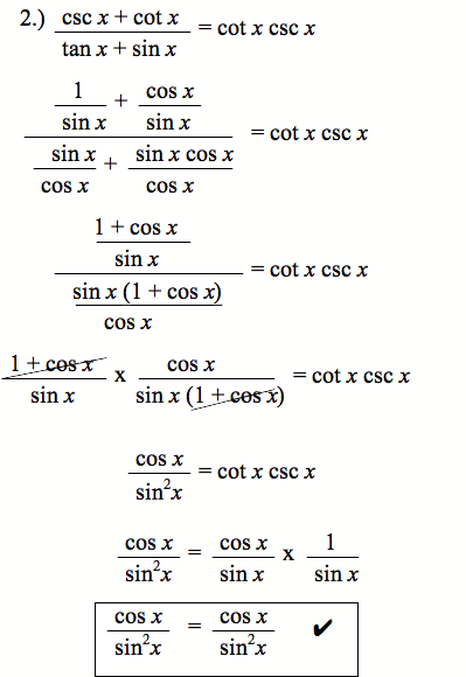 |
| http://verifyingtrigidentities.weebly.com/hard.html |
"Puzzle? Where does that come from? These are EASY". Following along with the teacher felt great. I felt empowered to go on and solve the hardest trig identities the text had to offer. However, when attacking even the simplest questions without the guidance of the teacher, I felt lost, overwhelmed, and defeated. All of the preconceptions I had before the lesson came rushing back. Come to think of it, this is probably where my irrational hatred for puzzles came from...
I eventually practiced enough on my own in order to gain confidence with the topic, but I feel that the process could have been much easier. Why do we tell our students that something is challenging, thought provoking, and puzzle-like, only to model a solution using a key? It sets the precedent that it only takes one try to find the solution. and anything that differs is "out of the norm".
In math education, we preach the "discovery of content"; students are able go take data they have collected or solved in order to find patterns and create formulas. I think that in certain areas of mathematics such as trig identities, we also need to preach the "discovery of process". Students need to discover that the process of solving mathematics is not always linear. It is okay to take a step back...it is okay to try something new...it is okay to get the wrong answer and start again. I found throughout my academic journey, I was able to learn the most from the mistakes that I made while at home trying to figure out how the heck my teacher was able to "get that answer". My goal as an educator is to facilitate this type of learning within my classroom.
Thanks for reading!

No comments:
Post a Comment