Sunday, 5 March 2017

Chapter 16: The Math Party

I challenge you to think back on a day where you did not use mathematics in any capacity. You are probably having a pretty hard time...Did you get dressed that day? Did you buy anything that day? Did you go on a timed break at work? Did you determine what time you need to get up in the morning on the following day? Well sorry to tell you, but if you did any of the above, then you probably used mathematics. The thing is, mathematics is everywhere...you just have to look. It may be discrete, it may be perceived as "easy" or "natural", but its mathematics, and most of us use it every single day.

So, welcome to the Math Party.

Image result for math party
http://weheartit.com/entry/group/42954734

I find that mathematics students are often very cynical when they are told they are "good at math". They are quick to revert back to statements such as "My parents are bad at math, and so am I", or "I've never memorized my times tables...I am no good at math", or my personal favourite "Math and I just don't get along". What these students do not know or understand is that there is nothing limiting their math success, and they are probably quite a bit better at mathematics than they believe. They just haven't been invited to the party yet. 

Let's pretend I am hosting a party. This is a pot-luck party, where everyone is expected to make their own dish to share with the rest of the guests. The idea, is that everyone brings something unique, something they are great at making, and something they are proud to share (and show off!). If its a great party, you get all sorts of great dishes (from light salads to deep-fried chocolate bars), everyone shares their amazing creations, and perhaps some even exchange recipes. 

Sounds like a pretty good party, right? Well let's bring this party to the mathematics classroom...but instead of a dish, let's have our students bring their personal and unique set of mathematics skills and experiences. Let's have them be proud and confident in what they bring to the table. Let's celebrate their diversity. Let's share and exchange our most amazing and creative math processes. Let's invite everyone to join. 

It's important that as mathematics educators, we recognize that everyone possess math skills that can be brought to, and showcased, in the classroom. We need to plan our lessons with the intention of inviting each and every one of our students to the "math party". In doing so, we can change the attitude of "Math and I just don't get along" to "Math and I? We go way back". 

Thanks for reading!


Chapter 15: Teaching Trig

How would you describe trig identities to a friend? I asked a peer this question, and they replied with something along the lines of "Isn't it that thing where you need to make each side match and they're really hard and each question takes up a page?". Nailed it. That isn't too far off from how I remembered trig identities, and I'm sure there are many others that were left with a similar memory.

For some reason, the perceived difficulty of a math question seems to always correlate with the amount of space the solution takes up on the page. Unfortunately, the questions presented in this unit innately promote their perceived difficulty as students rarely ever solve the question on their "first try".

Another way we describe trig identities is "as a puzzle". Again, this image sort of just paints trig identities with an ugly, difficult, long, and meticulous brush. Again, this description may or may not be fitting...but at least its consistent.

Hopefully by now, you've got the image in your head that trig identities are challenging, they may take up an entire page, and they are rarely completed successfully on your first try. They are guess-and-check type logic puzzles, much like Sudoku or KENKENS.

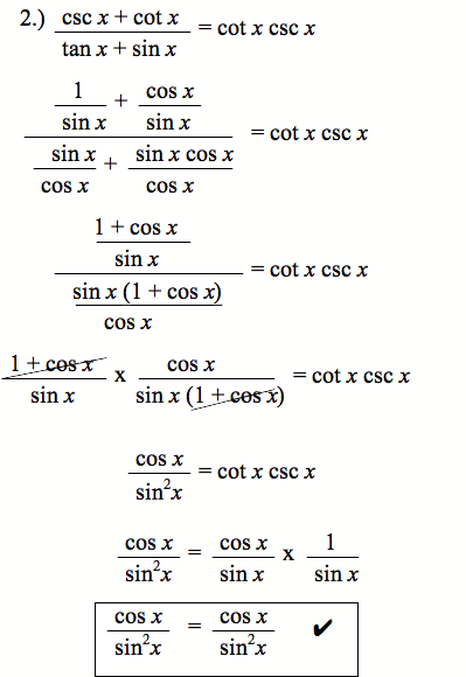
So how do we teach trig identities? I am not sure about you, but for me, I was taught through examples upon examples. An example would go up on the board, the teacher would solve it while he justified his solution, then we would move on to the next. The solutions often looked neat and crisp like the one below:
Image result for trig identities examples
http://verifyingtrigidentities.weebly.com/hard.html


"Puzzle? Where does that come from? These are EASY". Following along with the teacher felt great. I felt empowered to go on and solve the hardest trig identities the text had to offer. However, when attacking even the simplest questions without the guidance of the teacher, I felt lost, overwhelmed, and defeated. All of the preconceptions I had before the lesson came rushing back. Come to think of it, this is probably where my irrational hatred for puzzles came from...

I eventually practiced enough on my own in order to gain confidence with the topic, but I feel that the process could have been much easier. Why do we tell our students that something is challenging, thought provoking, and puzzle-like, only to model a solution using a key? It sets the  precedent that it only takes one try to find the solution. and anything that differs is "out of the norm".

In math education, we preach the "discovery of content"; students are able go take data they have collected or solved in order to find patterns and create formulas. I think that in certain areas of mathematics such as trig identities, we also need to preach the "discovery of process". Students need to discover that the process of solving mathematics is not always linear. It is okay to take a step back...it is okay to try something new...it is okay to get the wrong answer and start again. I found throughout my academic journey, I was able to learn the most from the mistakes that I made while at home trying to figure out how the heck my teacher was able to "get that answer". My goal as an educator is to facilitate this type of learning within my classroom.

Thanks for reading!